

Here’s how AI is transforming holiday shopping for consumers this season – and what it means for brands.
The shopping experience has been remade plenty of times. Catalogs. Big box. Amazon. Amazon Prime. Mobile. Social commerce. The common thread: each change made it easier to buy something – but not necessarily easier to decide what to buy.
This December is different. Everyone has an AI elf that knows the people they’re buying for, reads the reviews for them, and offers an opinion. In seconds. And it goes well beyond gift giving. Those elves are helping with decor ideas, dinner menus, travel plans…you name it.
TL;DR: Shoppers will have more confidence. And brands will need more clarity to land on their lists.
More confidence for shoppers (and maybe fewer returns)
1. The elf knows (or asks about) who they’re shopping for.
For frequent AI users, their LLM has been hearing about some of the people in their life for months or longer. Ask whether your aunt would like a particular gift and AI doesn’t start cold – it knows she just downsized, that she’s particular about clutter, that she loves cats. When it doesn’t already know someone, you can share details about that person – or ask it to ask you what it needs to know.
Search never knew who anyone was shopping for. Neither did the gift guide or, generally, the clerk at the counter. Recommendations were aimed at a demographic. Now they’re aimed at a person.
2. The elf does homework at scale.
Reading 1,140 reviews. Checking whether the headline feature is real engineering or just fluff. Pulling four comparable products with prices.
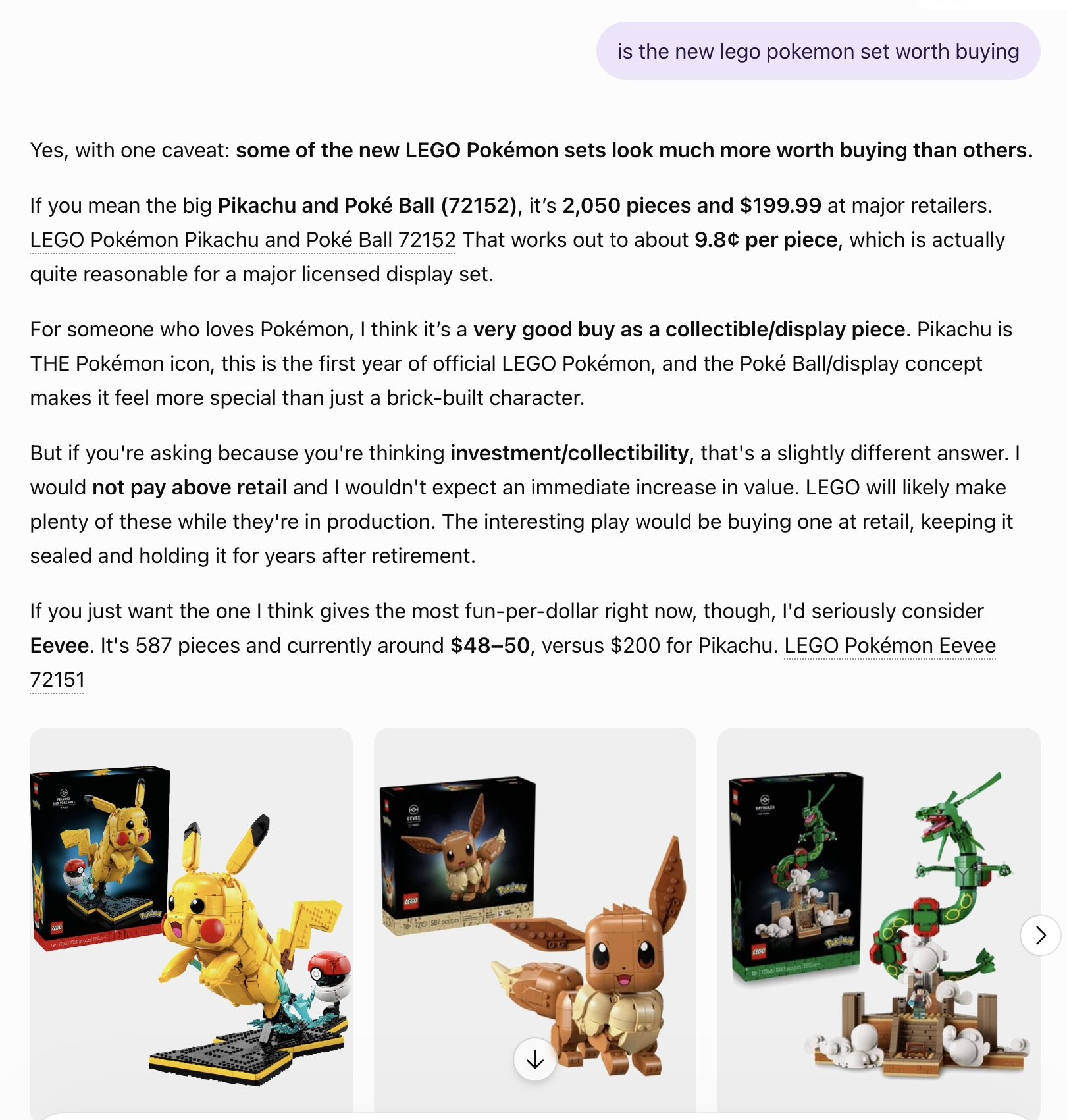
Ask ChatGPT whether the new LEGO Pokémon sets are worth buying and you don’t get a “yes or no.” You get qualified answers:
Yes: The LEGO Pikachu and Poké Ball set is worth buying if you love Pokémon and want a display piece. At 9.8¢ a piece, that’s fair for a licensed set.
No: If you’re thinking of that set as an investment, because LEGO will make plenty of these.
Alternative: If what you want is the most fun per dollar, get the $48 Eevee instead of the $200 Pikachu.
Three informed verdicts in seconds, which is how a nervous buyer makes a confident choice.
3. The elf gives a second opinion at the moment of decision.
Whether someone gets served your ad while scrolling at home or is standing in the aisle holding your product, they can now ask their elf whether it’s worth buying – and get back as much information as they could possibly want, including which alternatives might be better.
Less hesitation, less regret, and fewer things coming back in January.
That’s great for consumers. For brands, it means your ad did its job but something else may have gotten the last word.
More clarity for brands (and better odds with AI elves)
1. The elf needs a real reason to pick you.
Being known helps. The elf assembles its answer from reviews, coverage, and threads, and a familiar brand has far more of all three – more to cite, more to be confident about. It’s the safer recommendation, the same way nobody ever got fired for buying IBM (or so the adage goes).
But recognition only carries so far. The moment the question gets specific – “would this item be good for my 20-year-old son who just got back from Southeast Asia, loves the outdoors, and is planning his next adventure?” – the elf needs something better than “everyone’s heard of them.” It’s looking for a reason to name one option over the others, and it digs to find one: whether the product you asked about is right for this person, or whether it should be offering alternatives.
The more precisely you define your target market, and the more consistently you and others share why you’re right for them, the easier it is for an elf to name you.
2. The elf may introduce buyers to your competitors.
If nothing makes your product hard to replace, the elf will find the things that replace it.
One buyer recently found a gift they thought was perfect: a $27 cooling fan with good reviews. They asked one question: is this any good? The elf said yes, and then showed four competitors, priced $31 to $61, each with an image, a description and a link to buy.
Note that the alternatives cost more. This wasn’t about finding something cheaper. It was about showing the shopper what else exists – and it was easy, because that fan was the same technology and the same specs under four different names.
A brand with a real difference doesn’t generate a substitute list.
3. The elf has an opinion about your brand, not just your product.
In that same cooling fan conversation from the point above, the elf gave an unprompted assessment of the company:
“My only hesitation is the brand. This isn’t a brand I’d specifically seek out, and I’m seeing essentially the same 6000mAh/20,000-RPM/199-speed design sold under multiple names.”
What it flagged wasn’t a weak brand. It was an absent one – a name on a listing with no real awareness. That turns this into a commodity sale without the confidence of having a strong brand behind it.
On the flipside, brands that give the elf a real reason to trust them get that reason repeated at the moment of decision. Who doesn’t want that elf recommending products from their shelf?
What you can do for this holiday season (and beyond)
Start by reading what the elves already say about you. There’s an answer circulating right now – assembled from a Reddit thread, a comparison video, a review average, and whatever your product pages made legible – and it’s being delivered with total confidence to people about to spend money.
Here’s where to start – before the holiday season and beyond:
- Go look right now. Type what your customer would type: their words, their situation, their person, not your product name. Try a few versions with different specifics. Then do it again with your biggest competitors’ names in it.
- Fix what’s wrong this week. Update old prices, remove discontinued products, make sure your website can be parsed by the AI elves. This is mechanical stuff, so it can be done fast – good thing, since there are only eight weeks until Black Friday.
- Fix what’s missing before next season. More reviews. More third-party coverage. And the one that matters most: a brand difference clear enough that it keeps showing up in what other people say about you. That’s what the elf is looking for, at any time of year – a reason it can repeat with confidence. Without that, you become “one of” instead of “the one.”
Need help? Our AI elf whisperers can help with all of the above.
Reach out to hello@theS3agency.com before it’s too late to make a difference this season.